


Report on explosion protection

Report on explosion protection
Safety responsibility of production in explosive atmospheres
Explosive atmospheres pose a significant threat to businesses that work with flammable gases, vapours or dust. According to the Order of the Ministry of Economy of Ukraine No. 967-23, companies are required to take a number of measures to ensure the safety of employees and minimise the risk of explosion.
1. Класифікація вибухонебезпечних зон
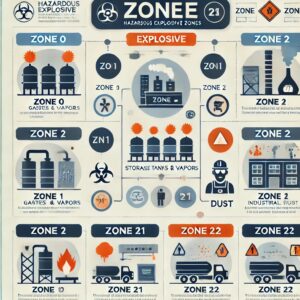
Вибухонебезпечні середовища поділяються на зони відповідно до частоти та тривалості утворення вибухонебезпечних газів, парів або пилу:
• Зона 0 – вибухонебезпечне середовище присутнє постійно або тривалий час (наприклад, всередині резервуарів з легкозаймистими рідинами).
• Зона 1 – середовище може виникати під час нормальної роботи обладнання (біля насосів, трубопроводів).
• Зона 2 – утворюється рідко або короткочасно (наприклад, біля вентиляційних отворів).
For dust:
– Zone 20 – permanent presence of dust in explosive concentrations (silos, bins).
– Zone 21 – occasional dust (production facilities).
– Zone 22 – short-term occurrence of dust (near conveyors).
2. Identification of possible sources of ignition
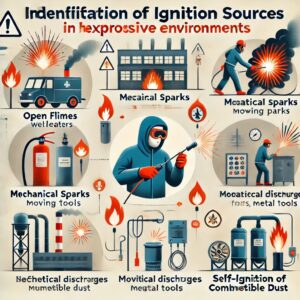
The main sources of ignition include:
– Open flames (welding work, heating elements).
– Sparks from mechanical friction or impact (moving machine parts, tools).
– Electrical discharges (unstable electrical equipment, static electricity).
– Overheating of equipment (motors, compressors, pumps).
– Dust spontaneous combustion due to heat accumulation.
3. Requirements for explosion-proof equipment and documentation
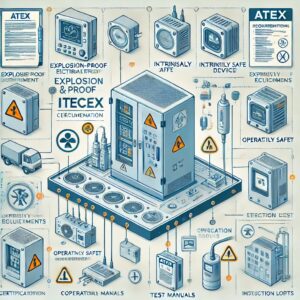
In hazardous areas, equipment that complies with explosion protection standards (ATEX, IECEx) must be used. The requirements include:
– Labelling of the equipment according to the explosion protection category.
– Compliance with safety standards (EN 60079-0, EN 60079-1, etc.).
– Availability of certificates of conformity.
– Documentation:
o Explosion protection certificates.
o Operating instructions.
o Test reports.
o Inspection and maintenance logs.
4. Necessary technical measures
To reduce the risk of explosion, companies should:
– Use explosion-proof equipment and wiring.
– Install ventilation systems to reduce the concentration of flammable substances in the air.
– Control the temperature conditions of the equipment.
– Use grounding systems and anti-static measures.
– Regularly check and maintain electrical equipment.
5. Action plan for the enterprise
1. Risk assessment – identification of potential sources of ignition and classification of explosive areas.
2. Equipment selection – implementation of certified explosion-proof equipment.
3. Development of safety measures – creation of instructions, implementation of ventilation, temperature control.
4. Staff training – regular briefings.
5. Documentation – keeping inspection logs, reporting.
6. Control and audit – periodic checks and updates of security measures.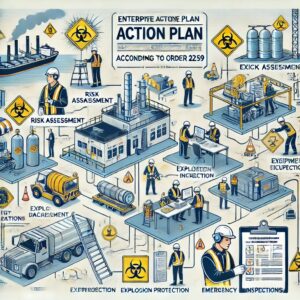
Compliance with these requirements will help companies minimize the risk of explosions and ensure the safety of their personnel.
